





In less than a few years, the world will be forever changed.
How you acclimate to this change will dictate your standard of living.
And if you don’t participate and sit on the sidelines, you will regret it – just as we told you in 2008 after the peak of the financial crisis.
Today, that sentiment has compounded.
If you’re not invested in the stock market, you will be left behind.
But stocks are frothy…overvalued…it’s a bubble, they say.
And perhaps THEY are right.
But not if you’re invested in the right stocks.
Over the last decade, we have willfully pounded the sentiment that the next economy is a financial economy. There has been so much money printed over the last 20 years that financial assets have become the primary source of wealth.
This isn’t changing anytime soon.
In fact, over the next five years, this financial economy will be the only thing left standing for many.
Let me explain.
A Recap
In previous newsletters, we outlined how the next stages of civilization will unfold.
Recall from our letter in 2017, “These Six Events Will Determine Our Future“:
“…while you shouldn’t take it as gospel, you should certainly be aware that the scenarios I paint – however extreme – have a strong possibility of happening.
In fact, it would be rather unwise to believe that extremes cannot happen – especially when “extreme” is what one might label our current financial and political situations:
-
- An extremely divided housing-to-wage ratio (think inequality)
- Extreme levels of debt that continue to climb with no regard on how it will be serviced in the future
- Stock market setting record new highs despite fundamentals
- An extremely divided government under President Trump
- An extremely divided America
- An extremely divided World
When we reach the near extremities of modern civilization, the ultimate consequence is a complete reset of the financial system – a complete reset of government.
I am not saying that this will happen soon, if at all. I am just saying that it’s the inevitable outcome when reaching the peak of society.
…The question is: Are we at the peak of this era?
I want to paint a picture of our current situation to give you a bird’s-eye view.
It plays out like this (with many of these points overlapping one another):
-
- Inflate: Make people feel good by giving them cheap money through Quantitative Easing (QE) and low-interest rates – increase the money supply.
- Deflate: Take the good feeling away by taking away cheap money through Quantitative Tightening (QT) and higher rates – decrease the money supply.
- Control: Subdue the population by taking their focus away from the real situation. Think media control; think the increase of opioid usage and the legalization of marijuana; think President Trump; think billionaire-funded protests.
- Divide: Segregate society by inducing riots and hate crimes.
- War: Mask the international financial and economic crisis through the rhetoric of war, or even war itself.
- Reset: Global economic reset will be blamed on war; not the monetary actions of the powerful elite.”
We are now at stages 4 and 5.
Every day you wake up and tune into the news, there is a protester committing a hate crime or police harming a protester. Every day, you hear that another country is fighting with another country. And every day, global powers flex their nuclear muscle.
But regardless of the noise, I am going to tell you one thing: this is all a simulation.
And right now, the global elites are making their next move.
You see, when you have unlimited money, you can do anything — and the elites have, for many years.
If you want to understand some of the previous games they played and how they shaped the world, we wrote a dramatized version of this in our letter, “He Who Pays the Piper Calls the Tune.“
These people have done everything and bought everything — and everyone — money can buy. They’ve fulfilled their lusts and perversions. Owning more is no longer the goal.
Their goal is to entertain themselves by playing with us.
Just like a video game.
The Game
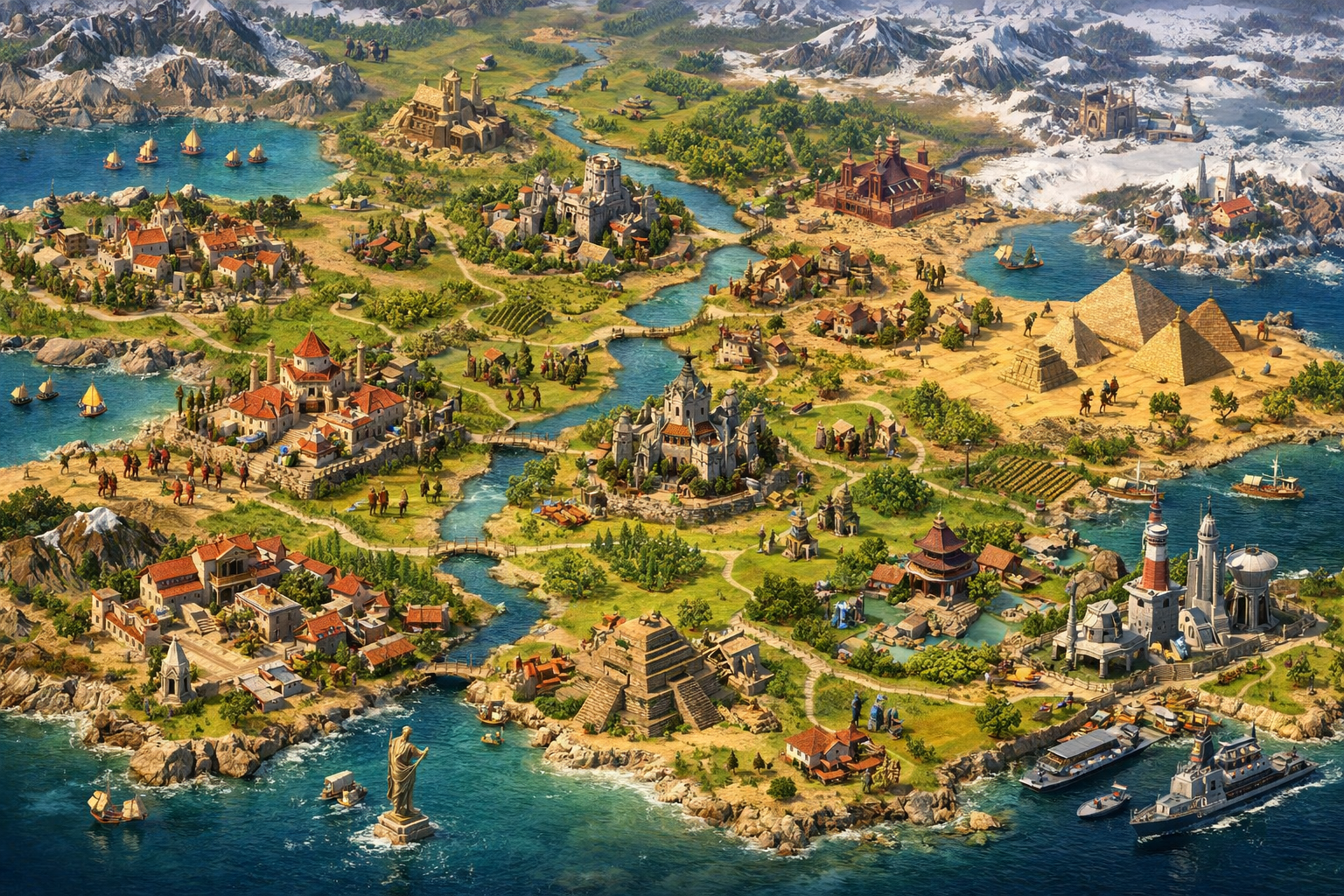
Take Civilization, for example — a classic turn-based strategy game where you explore, expand, exploit, and exterminate.
You start with a small tribe and guide it into a world empire through technology, culture, diplomacy, and war.
It’s a game where your inputs dictate what happens next.
Expansion isn’t about any single building or unit. It’s about removing constraints in the right order to grow your empire.
You start by settling cities, which solves the problems of space and resource access. Then you build farms, mines, and roads, which make your civilization productive and allow population and output to scale.
With those resources, you add districts and buildings — campuses, commercial hubs, industrial zones. These act as multipliers. They don’t just add output; they compound it over time by boosting science, gold, and production, which accelerates everything else.
Once efficiency is achieved, you have to bolster military power. While this doesn’t generate growth directly, it preserves it by protecting accumulated advantages.
The core engine of the game is feedback: science begets better tools, better tools raise yields, and higher yields fund expansion. The civilizations that win are the ones that start compounding earliest — and keep it uninterrupted the longest.
In Civilization, a player can introduce certain inputs that can create a whole new dimension to the game, such as adding nukes or space projects.
Now think about that in the context of our world.
Over the last 100 years, that has been the exact progression of the United States — fueled by the same elites who still exist today, just messier and slower in real life.
The pattern is simple: secure resources → build infrastructure → invest in institutions → compound science and wealth → project power and shape diplomacy.
In the “early game,” the U.S. spent the mid-20th century turning scale and resources into decisive capacity. World War II is the clearest example of a Civ-style production surge, alongside huge state-backed R&D like the Manhattan Project (1942–45), which created the first atomic weapons and permanently changed global power dynamics.
After the war, the U.S. built “empire infrastructure” and institutions that function like Civ’s roads + trade + economic civics: the GI Bill (1944) massively expanded access to education and housing for veterans, raising human capital and accelerating a broad middle-class economy, while the Interstate Highway System (funded by the 1956 act) did for commerce and mobility what roads do in Civ—lowering friction, expanding markets, and enabling higher “city” growth.
In the “mid game,” the U.S. effectively stacked compounding bonuses through science, finance, and alliances. Internationally, the 1944 Bretton Woods system helped establish the IMF and what became the World Bank, and created a US dollar-centred monetary order that lasted (in its original convertibility form) until 1971—basically a Civ “economic victory path” via rule-setting and institutional leverage. Domestically, investing in research institutions works like building campuses: the National Science Foundation was established in 1950 to support basic research, and Cold War competition pushed major science/engineering capacity, including the civilian space program via NASA’s creation under the 1958 Space Act.
In the “late game,” the compounding effects reveal themselves through general-purpose technologies that reshape everything — much like how sustained investment in technology eventually unlocks transformative breakthroughs in Civilization. Take the transistor, for example. It seemingly appeared out of nowhere at Bell Labs in 1947, yet became a foundational “unlock” that enabled modern computing and, ultimately, the entire digital economy.
But that momentum eventually stalled. As humans adapted to the technology, its limitations became clear — the microchip had reached a point where it needed vastly more data to keep improving.
So a new technological unlock was needed to keep the game entertaining.
Out of nowhere, something magically appeared in 1969: ARPANET — a DoD-funded network that became the foundation of today’s internet.
Shortly after, in another classic “military-to-civilian tech snowball,” the first GPS/Navstar satellite launched in 1978, enabling navigation infrastructure that now underpins logistics, finance, smartphones, and more.
After decades of incremental progress, we’ve now been handed another unlock.
And it could be the last major unlock we will witness in our lifetime.
Artificial Intelligence
AI is rapidly reshaping how we work and even talk. Heck, it’s become so obvious that we can spot an article written by AI immediately.
These articles are already flooding LinkedIn and Facebook, and we’re now seeing more content written by AI than by humans.
While it’s embarrassing to see CEOs post ChatGPT-generated articles and pass them off as their own, the reality is that no industry has escaped the rapid shift in efficiency driven by AI.
Think about it: if AI is taking over our thoughts and communication, what can’t it take over?
From drug discovery to unlocking new technologies, AI will fast-forward civilization at a pace that we have never seen before.
The growth of AI is not linear – it’s exponential.
What to Invest In
Every pundit on social media continues to talk about the same companies that everyone already knows about: Nvidia, Google, X, Meta, Microsoft, ChatGPT, etc.
You don’t need an investment newsletter for that.
But if you want to dig deeper, there are two ways to look at this.
- Efficiency: AI will make every industry more efficient. Companies that integrate AI will produce more with fewer resources, leading to higher margins, higher earnings per share, and higher stock prices. Any company that doesn’t adopt AI will fail. Full stop.
- AI requirements: AI requires processors, data, and energy. These are the true bottlenecks. And thus, the biggest requirements of all.
The Biggest Requirements
AI systems depend on a wide range of critical minerals, not because any single mineral is unique to AI, but because AI hardware sits at the very top of the modern industrial stack.
At the chip level, processors like GPUs and CPUs rely on silicon as the base material, along with copper, aluminum, tungsten, nickel, gold, and silver to move electricity reliably at microscopic scales.
Even tiny supply disruptions can halt advanced chip production.
Beyond the chips themselves, AI depends heavily on rare earth elements such as neodymium, dysprosium, and praseodymium, which are essential for high-performance magnets used in manufacturing equipment, cooling systems, and power infrastructure.
Other rare earths are critical for polishing silicon wafers, lasers, and precision optics used in chip fabrication. AI hardware uses small amounts of these materials, but without them, the factories that make chips simply can’t operate.
At the data-center level, the biggest constraints are power and heat.
AI data centers require enormous amounts of copper and aluminum for wiring, transformers, and cooling, plus steel for physical structures. To ensure continuous operation, they also rely on lithium, nickel, cobalt, and manganese for battery backup systems, as well as specialized alloys for cooling equipment. High-speed networking adds further dependencies on materials like germanium, gallium, and indium for optical data transfer.
The key takeaway is that AI isn’t limited by one rare material—it depends on nearly the entire modern resource and energy system working smoothly.
In simple terms, AI is less about “smart software” and more about having the industrial, electrical, and mineral capacity to support extreme computation at scale. If any part of that chain breaks—chips, power, cooling, or materials—AI progress slows immediately.
This is why energy demands will continue to skyrocket. It’s also why many AI datacenters will be launched into space – both for cooling and using the sun as a power source.
Regardless, these systems require immense amounts of resources.
If you believe robots are coming, you’d better believe demand for even the most basic metals, such as copper, will surge.
If you believe in AI — and you’d be foolish not to — you must believe electricity demand will rise sharply.
This isn’t just about oil or nuclear, but also the infrastructure required to support such massive increases in electrical output.
In other words, the future of AI and robotics cannot exist without resources and energy.
And that’s the reason why we’re witnessing the biggest geopolitical instability in modern history.
It’s not Trump. It’s not Putin. It’s not Palestine. It’s not Israel.
Whoever wins the AI race becomes the next global power. Period.
Making the Game More Interesting
For those who mastered the game Civilization, what’s next once you’ve reached the top?
You start making things more interesting.
You tweak resources.
You remove constraints.
You experiment.
You add a new unlock.
That is exactly what the elites are doing now, but on a global scale, with real people.
As Elon Musk says, the most entertaining outcome, especially if ironic, is the most likely.
This couldn’t be more true.
Peace isn’t entertaining.
A single empire at the top for 100 years isn’t entertaining.
Having the US on top for nearly 100 years is getting boring.
Which is why the elites have now unlocked the next part of the game – the magic technological unlock that will rewrite the next 100 years.
This unlock gives a less powerful nation the ability to rise and potentially become the next global power.
And yes, that unlock is AI.
When you start looking at the world from this lens, you will very easily understand why the geopolitical battle for resources such as metals and energy is growing more intense.
From metals export restrictions from China, to the United States coming out with a list of critical minerals, to Trump taking Venezuela and rhetoric over Greenland, all of these ultimately boil down to the AI race.
Those who control more commodities and energy will become the AI leader.
And with that, become the most powerful nation in the world.
In other words, we’re about to see the biggest changes in modern history.
The Commodities Supercycle
Throughout the entire existence of man as we know it, man has only fought for one thing: resources.
You see, you don’t invade a country because you want its people. You don’t invade a country simply because you want its land. You invade a country for its resources.
Before the advent of electricity and modern transportation, countries fought for gold and fertile land.
With the coming AI cycle, countries are now fighting for the resources that enable it.
This is why we’re in a commodities super cycle – and those who are invested in it could be rewarded in a big way.
As we’ve said since the 2008 financial crisis, the new economy is a financial economy.
And if you don’t want to be left behind, you have to be invested.
If you had invested $10,000 in Nvidia ten years ago, you’d have over $2.85 million today. Of course, now it looks like you missed the boat.
But many companies will achieve those kinds of returns over the next 5–10 years as a direct result of AI.
AI and robotics will replace millions of jobs, making companies far more efficient, expanding profit margins, and ultimately driving share prices higher.
If AI is going to take over your job one day, isn’t it smarter to invest in your replacement?
Seek the truth and be prepared,
Carlisle Kane

Many of our readers have made more than $100,000
Subscribe to our FREE monthly newsletter and see how many of our readers have made thousands in PROFITS with our ideas






How do I get your specific recommendations?
I receive your monthly newsletter and look forward to it.
(The last one was 12/14/25)
But are all your recommendations only in your 1-2 Month Newsletters ?
This is a bit FUNNY. A long and winded speech ending with what to expect next.
Then total silence on any mentioning of what are the future investments.
So, all this and NO real quality investment information.
The read was 100% waste of my time.
There is a critical need for the place of theology in the analysis and further of civilization!!!!