The Note That Exposed Everything
A yellow legal pad, a $500 billion circle, and why every road now leads to THIS.
by Equedia

On July 31, 2026, at a Cabinet meeting at Camp David, a Reuters photographer zoomed in on the notepad sitting in front of Treasury Secretary Scott Bessent.
At the top, in his own handwriting: “To Do.”
And beneath it: “Buy Japanese Yen (JPY) $5-10 bil.”

Within days, the unthinkable was confirmed.
For the first time since 1998, the United States government was spending its own reserves to rescue another country’s currency.
Japan went first, selling as much as $59 billion of its dollar holdings to defend a yen sitting at 40-year lows.
Then Washington joined.
Only, the New York Fed sold euros, not dollars, to buy yen on the Treasury’s behalf. On paper, America never parted with a single dollar. In practice, the dollar fell against the yen anyway.
Now stop and think about how strange that is.
The most powerful currency-printing nation in history — the one that lectures the world about free-floating exchange rates — is intervening in foreign exchange markets like an emerging economy in crisis.
And here’s the question nobody in the mainstream media bothered to ask: does Scott Bessent, the man who helped George Soros break the Bank of England in 1992 and one of the most successful currency traders, really need to write himself a reminder to buy yen? Complete with the ticker symbol, as if he might forget it?
Or was that notepad meant to be photographed, like a psychological weapon aimed at every trader shorting the yen, delivered for free on the front page of every terminal on Earth?
Either way, the message is the same: the system is under enough stress that Washington is now openly managing the world’s currencies by hand.
And when you understand why they’re doing it, you’ll understand why every road — the yen, the debt, the AI bubble, China — now leads to the same destination.
We’ll tell you where it leads in just a bit.
Why America Is Really Saving the Yen
The United States didn’t buy yen out of friendship.
It bought yen because Japan is America’s banker.
Japan holds over a trillion dollars of US Treasuries — the largest foreign stockpile of American debt on Earth. For forty years, Japan sold America cars and chips, took the dollars, and lent them right back by buying US bonds. That recycling loop quietly funded American deficits for two generations.
But when the yen collapses, that loop runs in reverse.
Japanese institutions get forced to sell their US Treasuries to defend their own currency — dumping American debt at the exact moment America needs to borrow more than ever. And when the yen snaps back too fast, the infamous yen carry trade unwinds and takes global markets down with it, just like the flash crash of August 2024.
So the US Treasury stepped in.
But why?
Because Washington is trapped in a trilemma it cannot escape: it wants to reshore its factories (which needs a weaker dollar), keep prices stable (which needs a stronger dollar), and keep the bond market alive (which needs someone, anyone to keep buying Treasuries).
In other words, it really has only two options.
The bond market has already figured out which one gets sacrificed.
And to understand why there’s no other option, you only need one number.
The Debt That Buys the Ending
It took America 205 years to borrow its first trillion.
In March, the US debt hit $39 trillion.
As of this week, the US national debt stands at $39.94 trillion — that’s nearly a trillion dollars in five months.
Want more perspective?
Per the Joint Economic Committee, the debt grows more than $7 billion per day, over $300 million an hour, and more than $85,000 every second — including the seconds it took you to read this sentence.
But the debt isn’t the killer…the interest is.
Net interest payments hit roughly $1 trillion a year — about $3 billion per day — and the Congressional Budget Office projects $16.2 trillion in interest over the next decade.
Interest is now the fastest-growing item in the federal budget, devouring roughly one in every five tax dollars collected.
This is The Great Debt Transfer we warned you about years ago. Only, it’s no longer a forecast, but a live broadcast.
Meanwhile, the traditional buyers of that debt are walking away.
Foreign central banks stopped growing their Treasury piles years ago.
Japan — as we just saw — is being propped up so it doesn’t become a forced seller. And the new Fed Chair, Kevin Warsh, who took over from Jerome Powell in May, inherited what the Wall Street Journal called a dangerous brew: sticky inflation, a softening labor market, and a bond market demanding to be paid more for the money printing it believes is inevitable.
Via CNBC:
“You have a Fed Chair signaling higher for longer into a labor market that is visibly softening. That’s a stagflation setup.”
If Warsh hikes rates, he detonates the labor market and adds billions to Washington’s own interest bill. If he cuts rates, he reignites the very inflation that got him the job — with the Strait of Hormuz still a hostage to the US-Iran standoff.
There is no third door.
Which raises an obvious question: with the world’s creditors retreating and the Fed boxed in, what exactly is holding up the most expensive stock market in American history?
The answer arrived on August 10th.
And you better take note.
The $500 Billion Circle
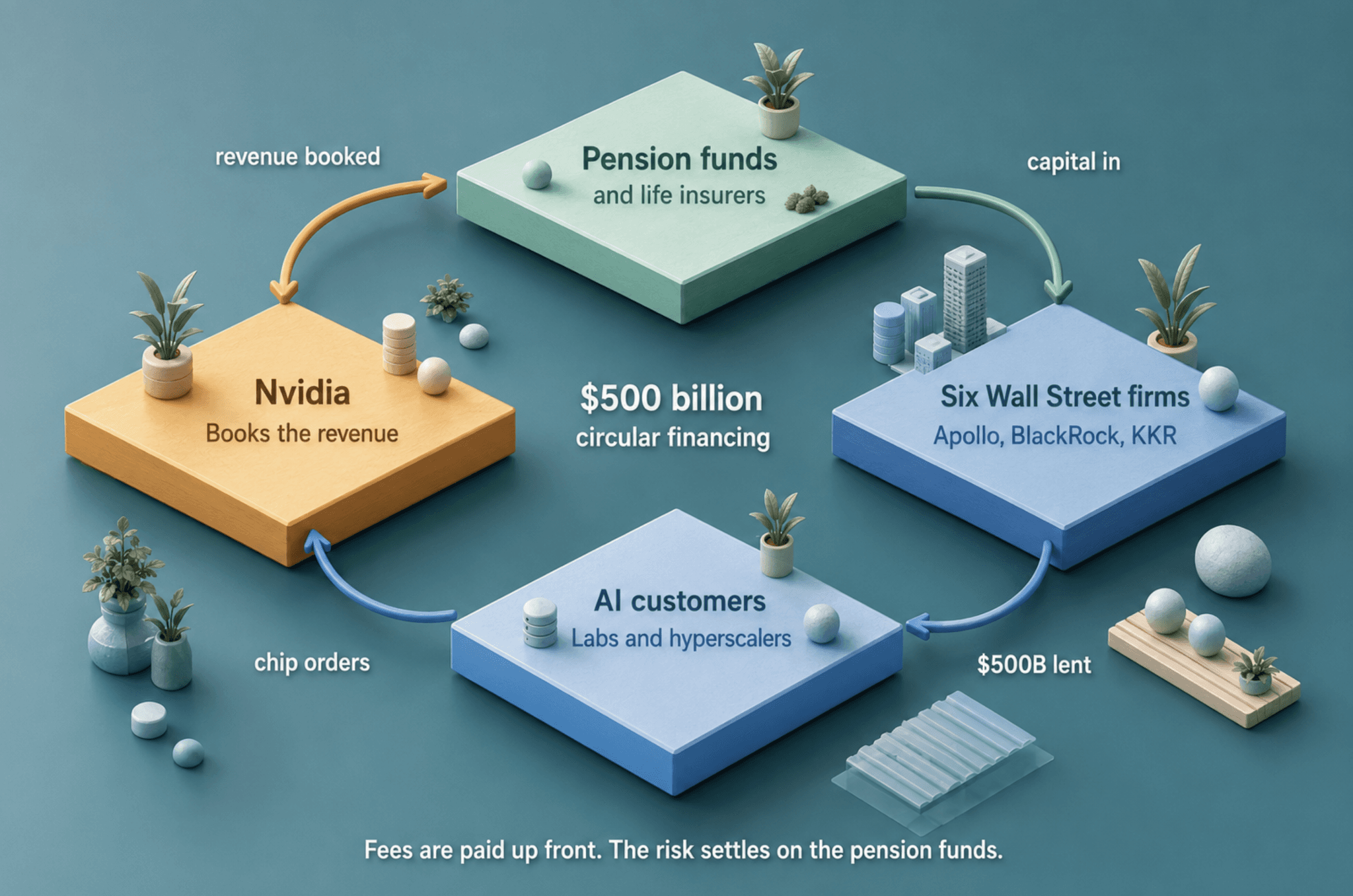
On August 10, 2026, Nvidia announced partnerships with six of the biggest names in global finance — Apollo, BlackRock, Blackstone, Brookfield, Goldman Sachs, and KKR — to mobilize over $500 billion in third-party capital.
For what?
So that Nvidia’s own customers can borrow money to buy Nvidia’s own chips.
The supplier is arranging half a trillion dollars of other people’s money — pension money, insurance money, your money — so its customers can keep buying its products. The revenue shows up on Nvidia’s income statement, while the debt shows up somewhere else. And the six firms arranging it all collect their fees up front, win or lose.
CEO Jensen Huang’s pitch is that a GPU is a long-lived “investable asset” — like a toll road or commercial real estate. But a toll road still collects tolls in thirty years. An AI chip is functionally obsolete in five, because Nvidia’s own next generation makes the last one look like a paperweight. That’s not a flaw in the business model, that IS the business model.
We’ve seen this movie before.
In the late 1990s, Lucent and Nortel lent their own customers the money to buy their own equipment. Sure, sales looked spectacular but both ended in the largest corporate bankruptcies of their era. And the people holding the paper, not the people selling the gear, took the losses.
And the bond market — the quiet, boring market that’s usually right — has noticed.
The cost of insuring Nvidia’s debt against default has more than doubled since late May, hitting record highs within weeks of the announcement. Michael Burry, the man who called 2008, labeled the whole arrangement a sign of desperation.
Now, if the AI trend continues, everyone is happy and everyone wins – for now.
But think about that contradiction.
The stock market crowd is throwing the biggest party in market history. And the people who insure debt for a living are quietly buying fire insurance on the guest of honor.
Meanwhile, the hyperscalers — Microsoft, Alphabet, Amazon, Meta — are guiding toward roughly $700 billion of combined AI capex this year, so much that free cash flow is collapsing across the group. Analysts now model negative free cash flow for some of the biggest names on Earth, funded by record bond sales and off-balance-sheet vehicles. The decade-long buyback machine that quietly held up the S&P is being starved to feed the AI build-out.
So let’s sum up this game: the most expensive market in American history, held up by one trade, financed with debt, insured like it’s 2008, with the biggest source of equity demand fading — inside an economy whose government adds a trillion dollars of debt every five months.
What happens when it cracks?
Well, we’ve seen this play out many times before, too.
It’s what they’ve done every single time for twenty years: they print more money.
The Long Term Capital Management bailout in 1998 — they printed. The 2008 financial crisis — they printed. The 2020 Covid bailout — they printed. And here is the detail almost nobody remembers: after every one of those rescues, there was one asset class that never traded lower again.
The people who run the world’s money know this history better than anyone.
Which is exactly why they’ve spent 2026 doing something one simple thing…
They bought gold.
The Buyers Who Read the Script
While gold crashed 28% from its January peak near $5,600 — its worst quarterly drawdown since 2013 — and retail investors dumped 45 tonnes of ETF gold in a single quarter, central banks bought an estimated 289 tonnes over the same stretch.
The People’s Bank of China added roughly 20 tonnes in July alone — its 21st consecutive month of accumulation. The price never mattered, because they weren’t trading, they were positioning.
And in June, buried in the European Central Bank’s annual reserves report, came the milestone we’ve been building toward for years:
For the first time in thirty years, Gold has overtaken US Treasuries as the world’s largest reserve asset.
Roughly $4.5 trillion in central bank gold now stands against about $3.5 trillion in their US government bonds. Gold’s share of global reserves has surged to roughly 27%, while Treasuries have slipped to 22%.
The asset that “pays nothing” has dethroned the asset that carried the entire post-war financial order — exactly the shift we mapped out in The Real Reason Why Gold Is Going Higher and again in April when we showed you the institutions buying at a pace not seen in decades.
And they’re not slowing down.
Via the World Gold Council:
“89% of reserve managers expect global central bank gold holdings to continue increasing.”
A record 45% plan to increase their own holdings this year. And 74% expect to hold fewer US dollars within five years.
But if you want to see where this is really heading, don’t watch Washington.
Watch Beijing.
The East Goes Physical
On July 6, Bloomberg reported something that has never happened in the history of Chinese capital markets: the largest ETF in China — the biggest single pool of Chinese investor money — is no longer a stock fund.
It’s the Huaan Yifu Gold ETF.
At roughly 90 billion yuan (about $13 billion), it overtook the flagship CSI 300 equity fund that Beijing’s own “national team” once used to prop up the stock market.
In the second-largest economy on Earth, the people have voted with their savings — and they voted for metal over paper.
And their government is making sure it’s real metal.
Over the past year, China’s biggest banks — ICBC, Postal Savings Bank, Ping An, and others — have moved to shut down retail paper gold trading, pushing citizens out of leveraged claims and into physical bars, coins, and bullion-backed funds.
At the same time, Hong Kong is expanding its gold vault capacity roughly tenfold, and Shanghai is positioning itself as a physical settlement hub — a direct challenge to the London and New York paper markets, where the daily trading of gold claims dwarfs the metal that actually exists.
If that sounds familiar, it should — we’ve been documenting this for over a decade.
In our letter “ What You Don’t See Behind the Scenes: The Pan Asian Exchange”, we showed how the paper markets, not physical supply and demand, set the price of gold. In “ A Major Scam Revealed,” we explained how the same ounce gets lent, pledged, and re-pledged through rehypothecation until one bar backs a stack of claims. And back in October 2012 — long before the mainstream touched it — we told you Germany was trying to bring its gold home because its own auditors admitted the metal had never been physically verified. It took years, and most of it never came back.
Why does the paper-versus-physical distinction matter so much?
Because if there are many claims circulating against each real ounce — and the East keeps draining the real ounces — then the paper price you see on your screen is not the price of gold.
It’s the price of a promise.
And promises, as every bondholder of a $39 trillion debtor should know, can be broken.
The president of the Shanghai Gold Exchange told the London establishment over a decade ago that once China had a real voice in the gold market, the true price would finally be revealed.
In 2026, that voice is no longer a whisper.
Which brings us to the final piece — the one we told you about a year ago, before almost anyone was paying attention.
Earlier, I told you that the US has only one real option: to print more dollars.
But that’s not entirely true.
There is one more…
The Trillion-Dollar Pen Stroke — One Year Later
Last August, in our letter, “ How to Turn $11 Billion into $1 Trillion,” we exposed the Gold Certificate Account — the Depression-era relic that still values America’s 261.5 million ounces of gold at $42.22 an ounce, and the quiet Federal Reserve research note studying how governments can fund themselves by revaluing gold to market price.
In other words, the US could create a trillion-dollar surplus on its balance sheet without new taxes, no new debt, and no money printing.
All that’s required is a pen stroke that fills the Treasury’s account with the difference.
When we wrote that letter, gold was near $3,300 and the pen stroke was worth roughly $900 billion.
We said gold would go higher.
Gold went higher.
At January’s peak near $5,600, that same stroke was worth over $1.4 trillion. Even after the correction, at today’s prices it’s north of $1.1 trillion.
If gold goes to $8000 per ounce, that revaluation becomes $2 trillion!
And in the year since, the idea has crawled out of the footnotes and into legislation.
The BITCOIN Act sitting in Congress explicitly proposes replacing the Fed’s gold certificates with new ones marked to market.
Economist Judy Shelton, long in Trump’s orbit, spent the year promoting a 50-year Treasury bond redeemable in either dollars or physical gold. Bessent himself was forced to publicly deny that a revaluation was coming, while in the same breath telling the world exactly where to look.
Via GoldSeek:
“We’re going to monetize the asset side of the U.S. balance sheet for the American people.”
What is the single most undervalued asset on America’s balance sheet — the one carried at $42.22 that trades above $4,300?
Gold.
And here’s what makes this different from every gold thesis you’ve ever read: the man now steering this — the man with the notepad — built his fortune understanding that markets move on credibility and psychology, not brute force.
He watched Soros break the Bank of England with a bet on what a government couldn’t afford to do. He made a fortune again in 2012 betting on what Japan told the world it was about to do.
Now ask yourself what a trader like that does when his own country’s balance sheet contains a trillion-dollar asset legally priced at $11 billion…while its liabilities compound at $85,000 a second.
Conclusion
Put it all together.
America is intervening in currency markets to keep its last big creditor from selling.
The Fed is trapped between stagflation and a bond market that no longer believes it.
The stock market is being held up by a circular, debt-financed AI trade that the credit markets are already insuring like a fire hazard. And when that trade cracks, the response will be what it has been after every crisis for a generation: print, rescue, debase.
Every player at the table can see this.
That’s why central banks made gold the world’s largest reserve asset for the first time in thirty years. That’s why the biggest fund in China is now a gold fund. That’s why the East is draining physical metal out of the Western paper system. And that’s why Washington — sitting on the largest gold hoard on Earth, carried at $42.22 an ounce — is quietly laying the legislative groundwork to reprice it.
Which completes the most powerful feedback loop in modern finance: the deeper in debt America sinks, the more it needs gold higher, because every dollar gold rises adds roughly $260 million to the value of that pen stroke.
The buyers fleeing the dollar push gold up, while the rising price makes revaluation more tempting. It’s a win-win for all parties (except for Canada who sold all of its gold under the Liberals).
A revaluation would crown gold — officially, legally, on the ledgers of the US government itself — as the anchor of the system all over again.
The higher the price of gold climbs, the more likely revaluation happens, while revaluation talk makes gold more attractive. Round and round it goes.
In the end, the world is dividing every asset into two buckets: the things they can print, and the things they can’t.
You can print yen. You can print dollars. Meanwhile, Treasury bonds, stablecoins, GPU-backed loans, stock buybacks — all printable, all promises, all someone else’s liability.
Gold sits alone in the second bucket.
As of this week, it’s back near $4,376 – up almost 8% in a month. And all while central banks are still buying, the Fed is still trapped, the debt is still compounding, and a yellow legal pad at Camp David reminding us that the people in charge are now writing the ending down in plain sight.
They wrote gold’s obituary at the bottom in April.
The people who actually run the world’s money never read it. They were too busy buying.
Seek the truth and be prepared,
Carlilse Kane
The Equedia Letter
Sources & further reading:
- Reuters/Axios — US role in yen intervention gives clue about Treasury goals
- CNBC — US Treasury intervenes to support yen
- Fortune — Japan and the US just spent billions to save the yen
- Nvidia — $500B compute financing platforms announcement
- CNBC — Nvidia lines up $500 billion in financing
- CNBC — Tech AI spending approaches $700 billion, cash taking big hit
- Bloomberg — China’s biggest ETF is now a gold fund
- MINING.com — Gold overtakes US Treasuries in global reserve shift: ECB
- World Gold Council — Central banks set to step up gold buying
- CNBC — Where gold is headed as Fed rate hike odds change
- Fortune — US national debt officially hits $39 trillion
- Peter G. Peterson Foundation — Interest costs on the national debt
- Congress.gov — The Federal U.S. Gold Stock (CRS)
- Trading Economics — Gold price, August 14, 2026
- The Equedia Letter — How to Turn $11 Billion into $1 Trillion
- The Equedia Letter — By the Time You Read This, They’ve Already Bought More
- The Equedia Letter— The Real Reason Why Gold Is Going Higher
- The Equedia Letter — The Great Debt Transfer
Disclaimer: This letter is for informational and educational purposes only and does not constitute investment advice. Past predictions and performance are not indicative of future results. We own gold and gold stocks. Please see our full terms of use and disclaimer at equedia.com.