Water Wars: The New War of the 21st Century
Water shortages: How water wars are unfolding in the Middle East and the truth behind Western involvement including World Bank and IMF participation.
by Equedia12 minute read
The Most Valuable Resource in the World…and It’s Not Oil
Dear Readers,
Control the flow of oil and gas and you control the world.
Oil has been the hottest commodity over the last decades. It’s paved the way for countries to become world leaders, and has set off numerous rifts and power struggles between nations.
It is one of the primary reasons why tensions between the West and Russia are growing increasingly worse, and why Russia is now “ practically in a state of war against Europe.”
I said this would happen last year. Many chose not to believe it. The threat of war is very REAL.
From pipeline routes to gas reserves, I have talked about the role of energy and its influence in both Syrian and Ukrainian conflicts. I have told you how energy leads to prosperity for those who control it. I have told you how the Obama administration desperately wants to sell gas to Europe in order to pay off its growing debt.
Much of what you see in the headlines nowadays, in one way or another, has ties to oil and gas.
But there is one resource that hasn’t been discussed.
It’s a resource so powerful that it will be the primary focus in the 21st century.
Under heavy media guard, it’s already been used as a weapon of war in the Middle East; not just by terrorists, but also strategically by Western powers.
I’ll tell you how this resource is playing a most significant role in those conflicts in just a bit.
Without this resource, no one survives.
According to a recent UN report, a third of the world population will suffer from critical shortages by 2025, which will likely lead to more global conflicts.
Withdrawals of this precious resource have more than tripled over the last 50 years.
And believe it or not, in many places, it costs more than oil or gas.
This valuable resource is water.
Water, Water, Everywhere…or is it?
Yes, the world is made of water and we’re nuts to think there’s a shortage of it.
There isn’t.
But what the world is short of is fresh water. Only 2.5% of the world’s water supply is fresh; of that, less than 0.0007% is actually suitable for consumption.
The majority of the world’s water is either salt water, or too polluted.
So if it’s not the lack of water that’s in short supply, why should we be worried about water shortages?
Water vs. Oil
Water is very much like oil and gas. It is everywhere and abundant.
But the problem is the cost associated with making both resources economic for consumption.
For example, oil needs to be refined before use, while water needs to be treated.
Not all places have oil, which means there are transportation costs. Ditto with water.
And just like oil wells, water supplies can (and do) run dry.
Just ask the citizens of California.
Heck, just ask Oprah.
Via the Daily Mail:
“In an effort to reduce her bills from the Montecito Water District – which have increasingly surged over the last three years as a record drought continues to cripple California, Oprah Winfrey has reportedly been sending a fleet of water tankers to her 40-acre Santa Barbara property to maintain her gardens.
The well-to-do residents of Montecito – the wealthiest suburb in Santa Barbara County – were warned in November that, without a 30 percent reduction in water at each home, the town would effectively run dry.
…Last year she paid $125,000 in water bills due to the amount it takes to look after her land. Trucking in water as you need can cost up to $15,000 a month.
California’s water problem is still listed as a Stage 4 ‘exceptional drought’.”
California is not the only city suffering from a severe drought.
This water shortage is happening all over the US.
Lake Mead, a main source of water for the booming Southwest and the nation’s largest water reservoir, is now near record lows.
The entire Colorado River system, which serves 40 million people and supplies water to California, Arizona, Colorado, New Mexico, Nevada, Utah, Wyoming and part of Mexico, is suffering a 14-year drought.
That means many Americans will pay more for water in the coming years.
Just how bad is it?
Take a look for yourself:
The US isn’t the only country that has water supply issues…
What Do You think of America’s Water Issue?
China’s Biggest Threat
A few years ago when I was in China, I met with many locals, businessmen, and officials.
Even in the heart of Beijing, where exotic and iconic five-star buildings rose like uneven roots from the ground, I noticed that all of us were drinking only bottled water.
So I asked, “With all this money, don’t you guys have a cleaner water supply?”
None of them hesitated with their answer: No.
They also all agreed that the water shortage situation in China may be one of China’s greatest threats.
Yet, big media has rarely discussed it.
Just how bad is China’s water problem?
According to the National Bank, China had 50,000 rivers just 20 years ago, but more than 28,000 of them have disappeared due to climate change, extraction, and industrialization.
More than half of the country’s 21,000-plus chemical plants are located along the Yangtze and Yellow Rivers.
One of China’s largest rivers, and one of the largest rivers in the world, the Yellow River, is so polluted that the Chinese government estimates that around two-thirds of if it is too polluted to drink.
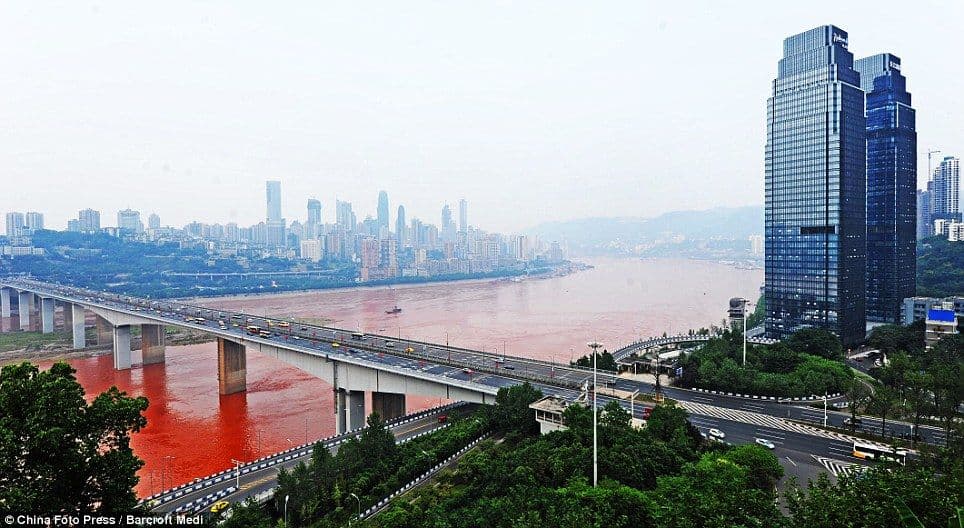
As a result, China is facing a serious water shortage.
According to Jiao Yong, Vice Minister of Water Resources, China has more than 400 cities short of water, some 110 of which are facing serious scarcity.
Via the Economist:
“CHINA endures choking smog, mass destruction of habitats and food poisoned with heavy metals. But ask an environmentalist what is the country’s biggest problem, and the answer is always the same.
“Water is the worst,” says Wang Tao, of the Carnegie-Tsinghua Centre in Beijing, “because of its scarcity, and because of its pollution.”
“Water,” agrees Pan Jiahua, of the Chinese Academy of Social Sciences. “People can’t survive in a desert.”
Wang Shucheng, a former water minister, once said: “To fight for every drop of water or die: that is the challenge facing China.”
Via Epoch times:
“The Henan Province is witnessing the worst drought in the last 63 years with 740,000 people facing a temporary shortage of drinking water. In Shandong Province the cost of the lost harvest is reaching $630 million.”
But that’s not all.
About 300 million people in China, almost a quarter of its population, drink contaminated water every day. You can only guess how much this adds to health costs.
China knows it has a problem…
What do you think of China’s water problem?
CLICK HERE to Share Your Thoughts
The Solution to Water Shortages
While water is everywhere, its clear that world demand for water is soaring as a result of high population growth, climate change, poor management, and pollution.
While the threat is very real, there are solutions.
China, for example, is attempting to create the world’s largest water-pipeline project in history.
But these solutions cost money – lots of it.
Prosperous nations and states have found near-term solutions by importing water.
But what happens if you don’t have money?
The Truths about the Middle-East Wars
You have heard about the use of guns and bombs in Syria. You have heard about Libya’s unrest. You have even heard me talk about how much of what’s happening in those regions are deeply tied to gas pipelines and energy control.
But what you haven’t heard is the significant role water is playing in those regions, and how it is being used as a weapon of war.
The battle over energy between Russia and the US is spreading major conflicts to any nation within their reach.
If oil is creating that much agony, what happens when water – an absolute necessity – becomes the target of war and profits?
It’s already happening all over the world, in places such as the Middle East and North Africa.
The Importance of Water in Syria
Syria – like many countries around the world – has experienced significant droughts, which led to a decrease in agriculture, increased unemployment, and the migration of citizens from rural areas into the cities.
The water shortage hasn’t improved. Syria is now entering its eighth summer of drought.
Just last month, Lake Assad, the reservoir of Syria’s largest hydroelectric dam and the main source of water for drinking and irrigation for about five million people, experienced a record six-metre drop.
According to Nouar Shamout, a researcher at Chatham House, a London-based policy institute, if Lake Assad loses an additional three feet, “the water system will stop working.”
Via Chatham House:
“…This could result in a humanitarian catastrophe that would overwhelm agencies on the ground. … In spite of these alarming indications, both Syria’s regime and opposition groups are in a state of denial: neither is responding to, or preparing for, a food and water crisis.”
Water is the essence of life. While attacks on oil supplies slows economic activity, attacks on water supplies leads to a direct humanitarian crisis.
As Shamout stated, the use of water supplies as a tactical weapon could “escalate fatalities and migration rates” in the country’s civil war.
That’s why Islamic militants have been using water as a tool to attack the Assad government.
Via Aljazeera:
“Making matters worse is the continued targeting of water networks by both regime and opposition forces, which have attacked strategic lifelines, such as water channels, to put pressure on their opponents. “The deliberate targeting of water supply networks and related structures is now a daily occurrence in the conflict,” Shamout wrote.
On May 9, the Syrian government allegedly ordered its employees at al-Khafse station, also in territory controlled by the Islamic State group, to cut off the flow of water heading west towards Aleppo. Previously, on May 1, the regime attacked al-Sakhour plant, which provides electricity to the opposition-held Suleiman al-Halabi station, the main water pumping station in Aleppo city.
Also in early May, the al-Qaeda-affiliate Jabhat al-Nusra is reported to have inadvertently cut off water to the entire Aleppo city for nine days while trying to divert water away from regime-held areas.”
But that’s not all that’s important. There’s much more to the Syrian conflict than you think.
More than Meets the Eye: Golan Heights
The Golan Heights is the area captured from Syria and occupied by Israel during the Six-Day War, territory that Israel effectively annexed in 1981. The western two thirds of this region are currently occupied by Israel, whereas the eastern third is controlled by Syria.
Just yesterday, news began to erupt of Syrian rebels attacking peacekeepers in Golan Heights.
What the headlines don’t tell you is that Assad has vowed to reclaim the Golan Heights; that’s partly the reason why Israel has been leading a Western Campaign to support the Syrian rebels.
But why? Why is Golan Heights so important that the West would support Syrian rebels?
Aside from the fact that Golan Heights once belonged to Syria (just as Crimea once belonged to Russia), there is a much bigger reason why the Golan Heights is valuable.
It is home to Israel’s most precious resource: Water.
The Golan Heights currently provides nearly a third of Israel’s fresh water. If the water supply fell into Syrian control, it would pose a most significant threat to Israel – a much bigger threat than any bombs or guns could make.
Fueling Western anger, Assad has also been reluctant to privatize its water systems on concerns of predatory pricing from the West; thus, preventing the West from potentially entering a multi-billon dollar revenue stream.
The combination of Assad’s Golan Heights ambitions and the refusal to privatize Syria’s water system means the West has no choice but to support the rebels – even if it means supplying terrorists with guns.
Via Washington Examiner:
“President Obama waived a provision of federal law designed to prevent the supply of arms to terrorist groups to clear the way for the U.S. to provide military assistance to “vetted” opposition groups fighting Syrian dictator Bashar Assad.
Some elements of the Syrian opposition are associated with radical Islamic terrorist groups, including al Qaeda, which was responsible for the Sept. 11 attacks in New York, Washington, D.C., and Shanksville, Pa., in 2001. Assad’s regime is backed by Iran and Hezbollah.
The president, citing his authority under the Arms Export Control Act, announced today that he would “waive the prohibitions in sections 40 and 40A of the AECA related to such a transaction.”
Go figure.
The battle for hydro-imperialism doesn’t stop at Syria. Oh, no. It goes much further than that…
Libya – More than Oil and Gas
Conflicts in North Africa have led to more than just a disruption in Libya’s oil and gas production.
It has led to the destruction of its water supply system. Costs to rebuild it could be as high as $20 billion – money that Libya doesn’t have.
So what happens when your water system breaks down and you don’t have money?
Privatization: The Answer from the West
I have always talked about the “ no free lunch” clause. Rich nations who help poor nations always have an agenda.
One clear example was the privatization of Argentina’s water system between 1991 and 1999. The World Bank led the privatization by offering hundreds of millions of dollars to Argentina with one recalcitrant condition: that water be privatized.
But privatized to whom?
Strongly lobbied by the French Government, Argentina granted the water contract to Aguas Argentinas, a consortium called lead by two French corporate giants, Compagnie Générale des Eaux (then Vivendi, now Veolia) and Lyonnaise des Eaux (now Suez), who (supposedly) won based on their offer of the largest rate reduction.
Of course, it’s interesting to note that France is ranked 4th overall in voting power amongst the branches of both the World Bank and the International Monetary Fund (IMF).
It’s also interesting to note that since its inception in 1945, the IMF has been led by a managing director of French nationality 5 out of the last 11 times, including during the privatization of Argentina’s water system.
The World Bank, on the other hand, has always been led by an American…
America’s Middle East Control for Profits
After the US invaded Iraq, one of the largest and privately owned US corporations, Bechtel, secured a contract to repair the country’s water supply. It was a no-bid\
In the late 90’s, Bechtel was responsible for securing a contract in Bolivia, one of Latin America’s poorest countries, after the nation was forced to privatize its water systems. This, again, was led by the US-based World Bank.
(Interesting to note that both American and French corporations have been the primary recipients of large privatization contracts.)
Bechtel has also been looking to move into Libya, after the World Bank said it would only give Libya aid if it privatized its water systems.
That’s because privatization of Libya’s water system may prove to be one of the most lucrative deals in history.
Why?
Libya sits atop a natural resource much more valuable than its oil: the Nubian Sandstone Aquifer, the world’s largest known fossil water aquifer system.
However, Bechtel (for now) has apparently been forced out of Libya after fierce public protest broke out over its price hikes for water when it was in Bolivia.
Still, Libya still needs money to fix its water system and may be forced to privatize.
Could we see France’s global mega-water companies, Suez, Ondeo, and Saur, who control almost half of the world’s water market, step in?
Similar conditions are forced on many countries seeking help. I mentioned this before regarding US aid for Ukraine.
Just how much money can private corporations make imposing its will via Western super powers such as the World Bank?
According to the center for public integrity, Western nations stand to make up to $1 trillion for privatizing, purifying, and distributing water in the Middle East and North Africa alone, where water often can cost more than oil.
It’s no wonder there are already rumours about French companies showing interest in privatization of Libya’s water system, just as France begins to urge for further UN support in Libya.
Is it a coincidence that France just urged the UN for special support in Libya yesterday?
Is it also a coincidence that the UAE recently denied entry to Awad al-Barassi, a former deputy prime minister and member of the Libyan Muslim Brotherhood-affiliated Justice and Construction Party (JCP)?
Via Foreign Policy:
“Barassi had lived in Dubai for years, serving as vice president of its Electricity and Water Authority before returning to Libya during the revolution.”
What do you think of Western involvement in the water systems of other nations?
CLICK HERE to Share Your Thoughts
Water Wars
More than 1.2 billion in the world don’t have access to clean water.
The lack of water will also increase global commodity prices, exponentially exacerbating the problems. Without enough water, the production of all raw materials (including oil and gas) will be materially impacted.
It’s a water war chess match. Growth and prosperity of any nation can only be achieved with the control of its own water supply; take that away, and control is lost.
\
Investing in utility companies, industrial operations and technology businesses associated with water may prove to be extremely rewarding over the next decade.
That’s why we’ve witnessed a growing number of water tech buyouts in the past few months, including LG’s Chem’s $200 million buyout of clean water startup NanoH20.
It’s already started. The water wars are on.
Be sure to share this with everyone: http://equedia.com/water-wars-new-war-21st-century
Until next time,
Ivan Lo
The Equedia Letter