The Truth About Ebola
We're now witnessing the worst Ebola outbreak in history. But why? Here's a look at the conspiracy behind the Ebola virus and the truth behind Ebola.
by Equedia12 minute read
The Truth About Ebola and the Ebola Conspiracy
What if fiction has become more believable than reality itself?
This week, I want to raise a few questions around some hypothetical scenarios, supported by facts.
Think of it as a “what-if” designed to spark your minds and think outside the current state of oppressed media outlets.
Over the past years, I have been very bold in writing about some of the reasons for war around the world; everything from the war in Israel, to the war in Syria and Ukraine.
I have talked about the manipulation of the stock market\
I have also concentrated many of my letters on the topic of Russia vs. the West. That’s because I believe their battle is one of the biggest threats to world peace.
In a recent interview with Serbia’s newspaper Politika, Putin fired a nuclear warning to the West.
Via Bloomberg:
“We hope that our partners will realize the futility of attempts to blackmail Russia and remember what consequences discord between major nuclear powers could bring for strategic stability.
…Putin said that Obama had identified Russian aggression in Europe as one of the three “major threats facing humanity,” alongside the Ebola virus and Islamic State.
…”Together with the sanctions against entire sectors of our economy, this approach can be called nothing but hostile,” Putin said.”
It’s becoming clear that the battle between Russia and the United States is not subsiding, but growing increasingly dangerous.
International sanctions are paving way for a disruption in global trade, leading to further mistrust and anxiety between the U.S. and foreign nations.
While serious foreign relations issues have the world on edge, it’s interesting to note that of Obama’s three major threats facing humanity, the Ebola virus is one of them.
But should Ebola be one of the three biggest world threats when billions are hungry and in poverty, when China and Russia are rising in power, and when terrorists in the Middle East continue to wreak havoc on humanity?
Is Ebola a Threat to Humanity?
I try my best not to write about topics, or post pictures and videos, that promote ideas that encourage and fuel evil propaganda undeserving of publicity (the posting of terrorist beheadings come to mind), and that are of small insignificance to the bigger world picture.
These things take away from real problems.
Right now, this is how I feel about the Ebola virus.
Let me tell you why.
Ebola by the Numbers
Here are the stats, updated as of October 15 by the CDC:
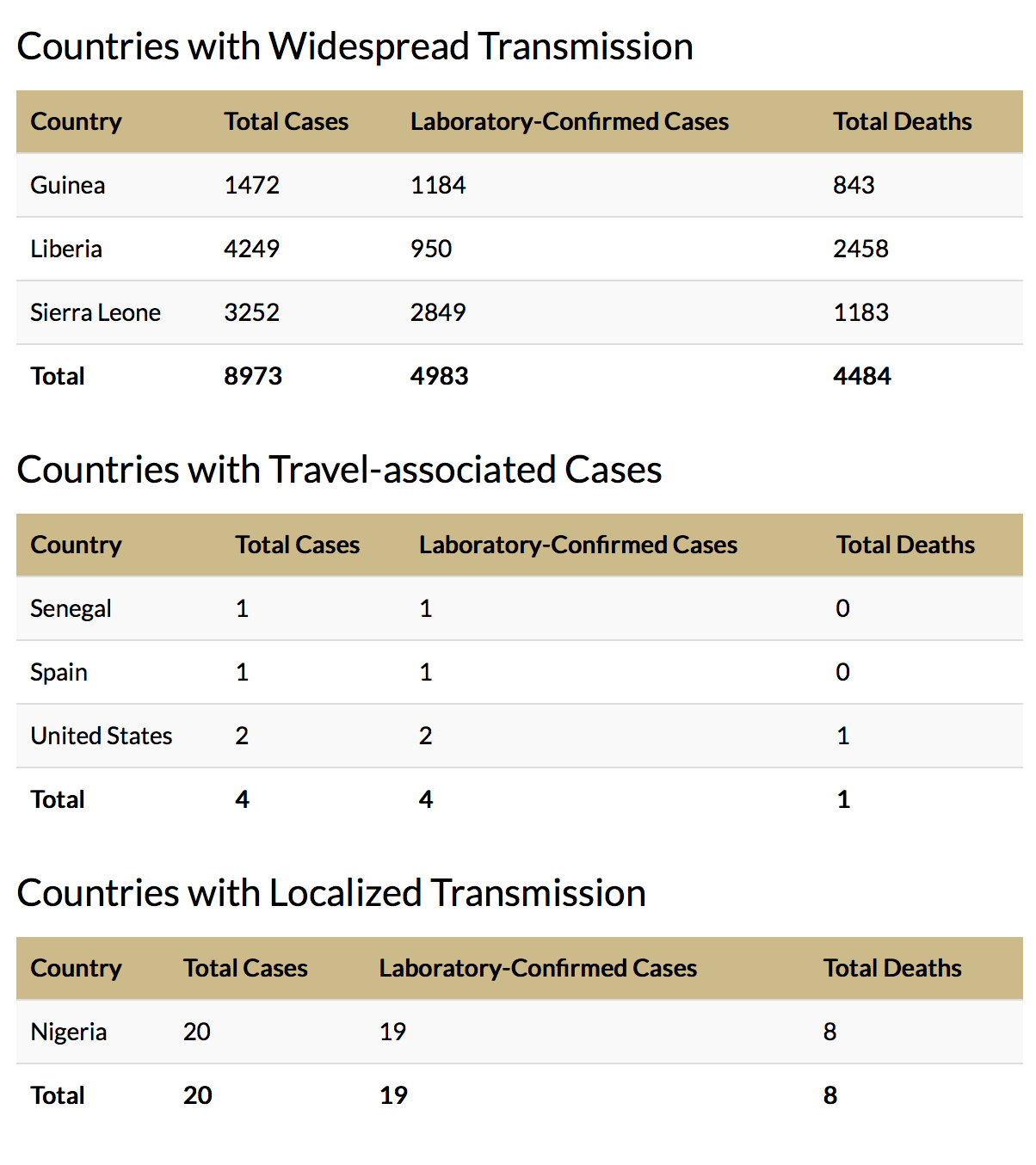
Ebola is a virus that is not as easily spread as the common cold or other infectious viruses. It can only be transmitted by direct contact with blood, body fluids, or skin of EVD patients or persons who have died of EVD.
Via CDC:
“The risk of EVD transmission from direct skin contact with an EVD patient is lower than the risk from exposure to blood or body fluids and may be more likely in severe illness (when the Ebola virus RNA levels are highest).
It is not known if transmission from direct skin contact is mediated by Ebola virus primarily on the skin where it has been documented by histopathologyand RT-PCR of a skin swabor by micro-contamination of the skin with blood or other body fluids.”
In other words, unless you’re sharing body fluids with someone who has died from the disease, you’re not likely to catch it.
Even if you have had skin contact with someone who has died from the disease, the chances of you contracting the disease is still very low.
Yes, once contracted, Ebola is a very deadly virus, killing nearly half of all who contract the disease.
But let’s put the numbers into perspective.
The flu kills around 36,000 people per year in the United States. Globally, it kills between 250,000 and 500,000 per year.
Our latest flu pandemic – the H1N1 (swine flu) – caused the deaths of at least 16,000 people around the world between April 2009 and February 2010. It still exists today, and people are still dying from it.
Yet, the CDC no longer reports on H1N1.
According to the United Nations, over 191,000 have died from the Syrian Civil War.
How do these numbers stack up with Ebola?
The recent Ebola outbreak has thus far killed fewer than 5000 people.
This is a much lower number than other infectious viruses.
For example:
In 2012, malaria killed an estimated 482,000 children under five years of age. That is 1,300 children every day, or one child almost every minute.
There are an estimated 200,000 cases of yellow fever, causing 30,000 deaths, worldwide each year, with 90% occurring in Africa. Yes, there is a vaccine but this disease also kills 50% of the people who contract it.
AIDS/HIV has not gone away, yet we never hear about it anymore. But in 2013, 2 million people were newly enrolled on antiretroviral treatment – the largest ever annual increase. The number of people living with HIV is now over 35 million, with 2.1 million newly infected. There were 1.5 million deaths from the virus last year. But when was the last time you heard about the disease?
Clearly, there are more dangerous diseases out there which are killing more people than the Ebola virus and spreading at a much faster rate.
So why is the media placing so much emphasis on Ebola? Why has Obama listed Ebola as one of the biggest threats to humanity?
To answer that, let’s look at the origin of Ebola.
CLICK HERE to Share Your Comments on Ebola
Africa: The Next Growth Engine of the World
Ah, Africa…the birthplace of Ebola.
And the next growth engine of the world.
Collectively, Africa as a whole already has a gross domestic product of more than $2 trillion, which includes seven of the world’s fastest growing economies.
Africa is also a continent that’s filled with instability and conflict.
Fifteen African countries are involved in war, or are experiencing post-war conflict and tension.
That means many African nations are going to be very willing to accept money and loans from outside influences who, in turn, will likely end up controlling much of Africa.
Combined with its rapid growth, conflicts present massive opportunities to infiltrate and benefit from a growing nation that is essentially starting from scratch.
In case you’re unaware of where I am going with this, read my letter, “ Water Wars,” to see how foreign companies coerce other nations into unfavourable terms.
China’s Presence in Africa
Over the past decade, Chinese companies, along with over a million Chinese workers, have poured into Africa, backed by billions from Chinese government loans to African countries.
Between 2001 and 2010, China’s Export-Import Bank gave $62.7 billion in loans to African countries. That’s $12.5 billion more than the World Bank provided.
Those loans have been crucial in the expansion of foreign trade between Africa and China; so much so that over the same period, trade between China and Africa grew by more than 700 per cent, replacing the U.S. as Africa’s biggest trading partner in 2009.
China now has commercial offices in almost all of Africa’s nations.
China, and many Western companies, originally set up in Africa to exploit the continent’s massive amount of natural resources.
But Africa’s growth in other areas now represent a rapidly expanding untapped opportunity, including areas such as IT, agriculture, water, energy, manufacturing, financial services, and the consumer market.
Africa’s massive 1 billion citizens are the youngest population in the world, with over 60 percent of its population being 25 years old or younger, and 50 percent below the age of 19. Their adaptation of technology, especially mobile communications, is growing faster than anyone thought possible.
A Standard Bank report from 2011 notes that in 10 short years, the number of mobile phone users in Africa has grown from 15 million users in 2000 to more than 500 million users in 2010.
This year, a report by TA Telecom on the African telecommunications market highlights that mobile penetration in Africa hit 80 percent in the first quarter of this year and is still growing at 4.2 percent annually.
That’s faster than anywhere else in the world; so fast that it has now become the world’s second largest mobile market – second only to Asia.
More than 8 in 10 Africans now have a mobile phone, and they are beginning to use all of the mobile capabilities associated with it.
According to the Guardian, Internet use on mobile phones in Africa is predicted to increase 20-fold in the next five years, and will double the rate of growth in rest of world.
The Battle for Africa
Western companies have long since been operating in Africa, but they have been relatively late when compared with China’s aggressive African pursuit.
But that’s all about to change.
Western companies are finally waking up to the massive potential in Africa.
Last year, the U.S. was exploring a possible trade and investment agreement with the 15-nation Economic Community of West Africa.
This August, the Economic Community of West African States (ECOWAS) and the United States signed a trade and investment framework agreement aimed at expanding trade and investment between the United States and the 15 ECOWAS member states, and across the entire West African region.
Along with this agreement, Obama pledged that U.S. businesses will commit $14 billion in investments into Africa.
Via Reuters:
“President Barack Obama will announce on Tuesday that U.S. businesses have committed to investing $14 billion in construction, clean energy, banking, and information technology projects across Africa, a White House official said.
The announcement will occur at the U.S.-Africa Business Forum\
“These investments will deepen U.S. economic engagement in Africa, fueling growth that will support broader African prosperity and emerging markets for US businesses, which will support jobs in both the United States and Africa,” the White House official said.”
Since the U.S. has committed to investing billions in Africa, you can bet that it will do what every smart investor does.
Protect Your Investment
What’s the best way to protect your investments in a nation that’s filled with conflict and instability?
Bring in the troops.
But how? The U.S. can’t just place troops in a foreign nation alongside investment dollars; that would be undiplomatic.
The U.S. needs another ~~excuse~~ reason.
Infiltration Over Invasion
In a coincidently and timely fashion, Ebola comes along.
With the onset of the Ebola virus, Obama has sent some of his top combat-trained troops to help fight the disease.
This month, roughly 1,400 U.S. military personnel are expected to deploy to West Africa to contain the virus.
It is expected that the U.S. will deploy at least 3,000 forces throughout the fall, with estimates of more than 4,000 forces expected to help.
Obama is also expected to issue an executive order to put National Guard boots on the ground in Liberia.
Via NBC:
“President Barack Obama issued an executive order on Thursday paving the way for the deployment of National Guard and Reserve forces to West Africa to help contain the Ebola outbreak there.”
The initial mission, according to the U.S. military, focuses on building treatment facilities and training health-care workers.
Is it necessary to have top military personnel equipped with full combat gear for these things?
According to Army Times:
“The Army’s 101st Airborne Division (Air Assault), based at Fort Campbell, Kentucky, will provide about 700 of those soldiers, while the other 700 will be mostly combat engineers culled from Army units across the force, Defense Department spokesman Rear Adm. John Kirby told reporters.”
In case you didn’t already know, the 101st Airborne Division is a U.S. Army modular light infantry division trained for air assault operations and is one of the most highly decorated units in the U.S. Army.
During World War II, it was renowned for its role in Operation Overlord (the D-Day landings starting 6 June 1944, in Normandy, France), Operation Market Garden, the liberation of the Netherlands and action during the Battle of the Bulge around the city of Bastogne, Belgium. During the Vietnam War, the 101st Airborne Division fought in several major campaigns and battles including the fight for Hamburger Hill in May 1969.
Look, I get it.
These decorated officers need jobs, and having their expertise to control and contain an outbreak makes sense.
But what doesn’t make sense is that Obama is removing military troops from the Middle East where war is taking to place, and placing very decorated and high-level military personnel in Africa, where a virus – and not guns and bombs – are killing thousands.
As Allen West, a former congressmen with a 22-year career in the United States Army, serving in several combat zones in Operation Desert Storm, Operation Iraqi Freedom, where he was a Battalion Commander in the Army’s 4th Infantry Division, and later in Afghanistan, said, “How exactly do you shoot a virus?”
Consider the coincidences.
The trade agreement between the U.S. and West Africa, along with a $14 billion investment pledge, occurred August 5, 2014.
Three days later, on August 8, the World Health Organization (WHO) declared Ebola as an international health emergency.
This paved the way for the U.S. to send thousands of troops into West Africa.
Interestingly, the WHO knew about the outbreak five months before the announcement and had already counted 1,000 deaths prior to the declaration of Ebola as an international emergency.
Via CBC:
“Dr. Peter Piot, the co-discoverer of the Ebola virus, agreed in an interview Friday that WHO acted far too slowly, largely because of its Africa office.
…Piot, director of the London School of Hygiene and Tropical Medicine, also questioned why it took WHO five months and 1,000 deaths before the agency declared Ebola an international health emergency in August.
“I called for a state of emergency to be declared in July and for military operations to be deployed,” Piot said. But he said WHO might have been scarred by its experience during the 2009 swine flu pandemic, when it was slammed for hyping the situation.”
I am sure it’s just a coincidence that both the new Ebola outbreak and the new trade agreement are affecting West Africa.
But was the timing of Ebola as an international emergency and the Trade Agreement a coincidence?
CLICK HERE to Share Your Thoughts
African Infiltration: China vs. U.S.
It’s clear that China and the U.S are dominating Africa.
Let’s take a closer look at how deep their roots are.
Take a look at China’s investments as of 2012, courtesy of Stratfor:
It’s clear that China has already infiltrated most of South Africa, and is beginning to move northwest.
Now let’s take a look at a map of U.S. military presence from May, via Washington Post:
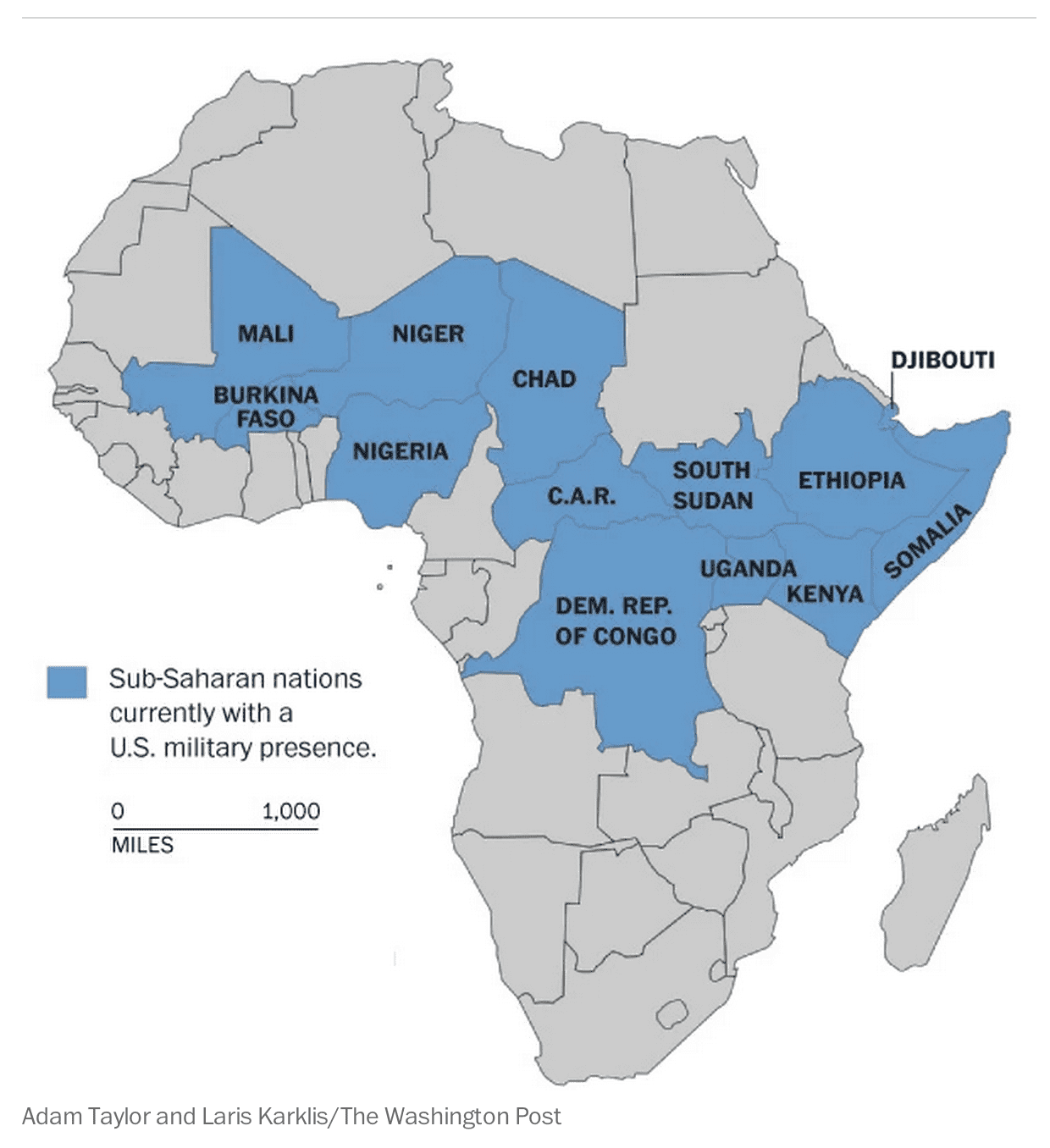
Notice how the U.S. now controls, via military, the middle-to-upper area of Africa? Roughly the same area where China is beginning to move?
You might have also noticed as of May 2014, the U.S. didn’t have much of a military presence in West Africa.
Thanks to Ebola, and the recent trade agreement, it does now…
But wait, there’s more.
Who is Ron Klain?
According to CNN, Obama will appoint Ron Klain as his “Ebola czar.”
But who is Ron Klain?
Simply put, he is an American lawyer and political operative that has been very successful from a political standpoint.
Yet, he has absolutely no healthcare background, let alone a background in infectious disease containment.
It’s no wonder critiques began shortly after Klain’s appointment was reported.
Via the Hill:
“\
…”Given the mounting failings in the Obama administration’s response to the Ebola outbreak, it is right that the president has sought to task a single individual to coordinate its response,” Chairman of the House Foreign Affairs Committee Rep. Ed Royce (R-Calif.) said in a statement. “But I have to ask why the President didn’t pick an individual with a noteworthy infectious disease or public health background?”
Senate Republicans also disapproved of the president’s choice.
“Ebola is a health crisis. Yet the President has appointed as his new Ebola ‘czar’ a partisan loyalist whose expertise is politics-not health,” said Sen. Jeff Sessions (R-Ala).
“This is a public health crisis, and the answer isn’t another White House political operative,” Sen. Ted Cruz (R-Texas) said in a statement.”
While we are just weeks before an election day, and the majority of the critics are Republican, can we argue with their comments?”
Perhaps there’s another reason for Klain’s appointment.
Let’s play the “what-if” game for a minute.
What if…
…the Ebola virus is just a distraction for the United States to send more troops to Africa in order to protect its investments and limit those of China?
…Klain’s appointment was based on a foreign policy standpoint; to offer further help to Africa in exchange for trade agreements and corporate contracts?
…the Ebola virus was allowed to spread (since it was known five months prior to being called an international emergency), in order for U.S. troops to set up shop? Previous Ebola outbreaks were easily contained…why not this one?
Now it’s your turn…
CLICK HERE to share your thoughts and start your comment by using the phrase, “What if…”
Who knows, I could be completely wrong and Ebola might wipe all of us out. In which case, “what-if” Ebola was a virus used as a method of population control?
Of course, as I said earlier, these are all hypothetical suggestions.
But the facts are all real.
Be sure to share this with everyone: http://www.equedia.com/the-truth-about-ebola/
Until next time,
Ivan Lo
The Equedia Letter